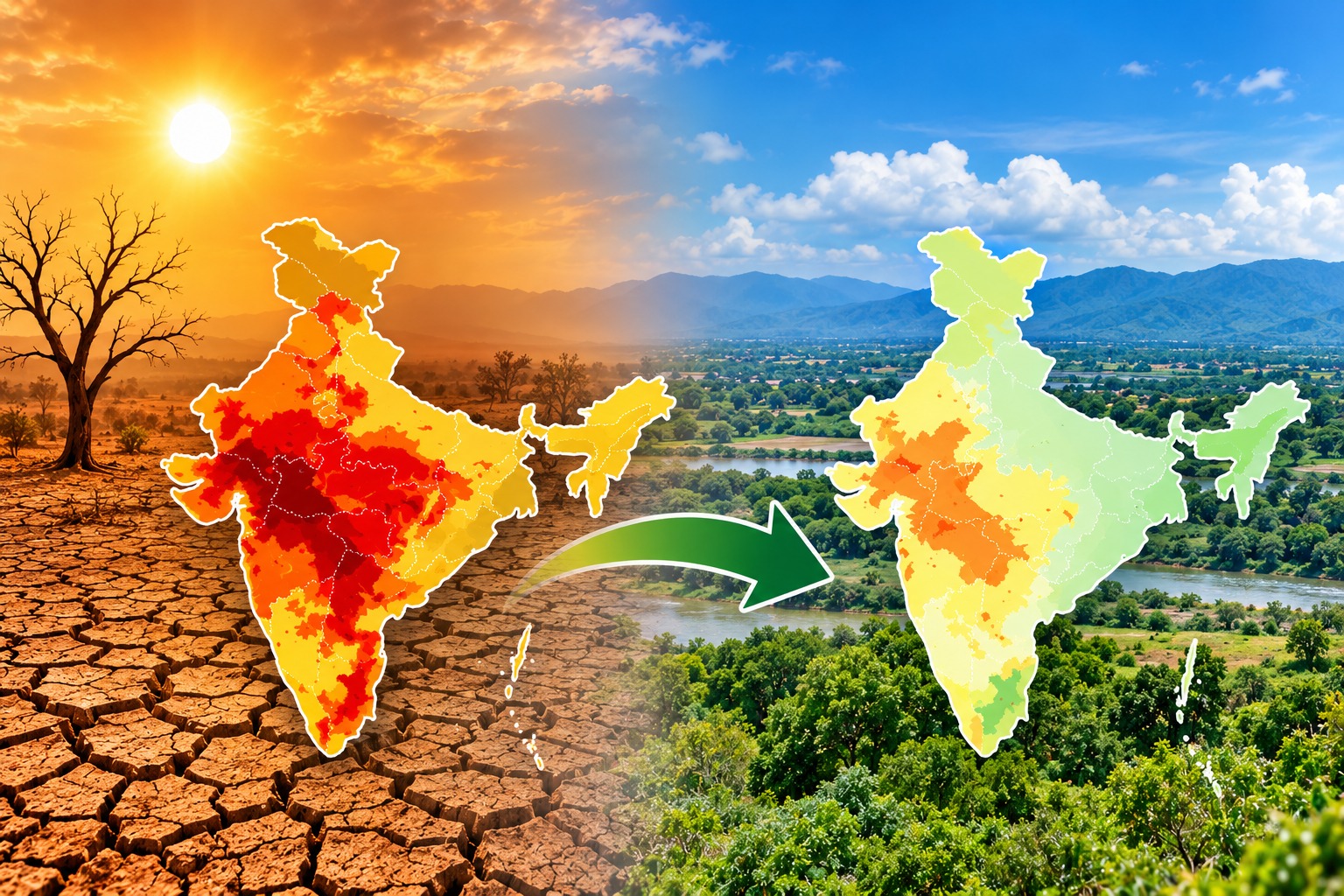
Hyderabad, Oct 28: The hot semi-arid climate zone, which covered about 30% of peninsular India in 1951–1980, had shrunk to 16% by 1991–2020, with most of that land moving into the tropical savannah zone, which now covers three-quarters of the peninsula, up from about three-fifths, a change the authors attribute to rising rainfall over southern India, according to a study by scientists from the India Meteorological Department (IMD) and the Indian Institute of Tropical Meteorology, Pune, published in MAUSAM, IMD's peer-reviewed journal.
Climate zones are defined by temperature and rainfall, and the researchers redrew India's climate map for successive 30-year periods, the standard span over which climate is measured, from 1951–1980 to 1991–2020, using IMD's own observations. The hot semi-arid zone is hot with low rainfall, while the tropical savannah zone that has replaced much of it is warm throughout the year with a long dry season and receives more rain. Most of the change took place in the two most recent periods, 1981–2010 and 1991–2020.
The peninsula changed in the opposite direction to northwest India, where the hot semi-arid zone expanded over the same period, and the study finds that while daytime and night-time temperatures rose across the country, rainfall increased over southern India even as it declined over the northern plains. Along the west coast, the tropical monsoon zone, the country's wettest, extended across coastal Karnataka and Kerala.
The long-term rise in rainfall has not protected the region this year, when El Niño, the periodic warming of the Pacific Ocean that tends to weaken India's monsoon, left the south 24.3% short, with Karnataka 30% below normal and Andhra Pradesh, Tamil Nadu and Telangana between 17% and 24% below. Karnataka has declared drought in 177 of its 240 taluks, and the Centre has declared drought in parts of Andhra Pradesh and Telangana.
"The peninsula is where the biggest shift towards a wetter climate has taken place, with the hot, dry zone shrinking by about half since the 1950s, and yet the south was nearly a quarter short of rain this monsoon, which shows that a wetter climate does not protect a region from an El Niño year and that planning has to allow for both the long-term change and the swings from one season to the next," said Ananya Karmakar of IMD Pune, the study's lead author.
"The south recorded one of the largest rainfall shortfalls in the country this year as El Niño weakened the monsoon, and Karnataka, Andhra Pradesh and Telangana are now dealing with drought, yet over seven decades the peninsula has become wetter, which tells us that the long-term trend and the year-to-year swings caused by El Niño have to be read together, and IMD's seasonal forecasts and advisories to farmers are designed to help them prepare for both," said Mrutyunjay Mohapatra, Director General of Meteorology and a co-author of the study.