Varanasi, Nov 02: Ancient wisdom must engage with the problems of the present and help improve lives, Dr Priti Adani, Chairperson, Adani Foundation, said in her keynote address at the inaugural session of The World Symposium on "Ancient Wisdom for Modern Challenges" in Varanasi on Monday.
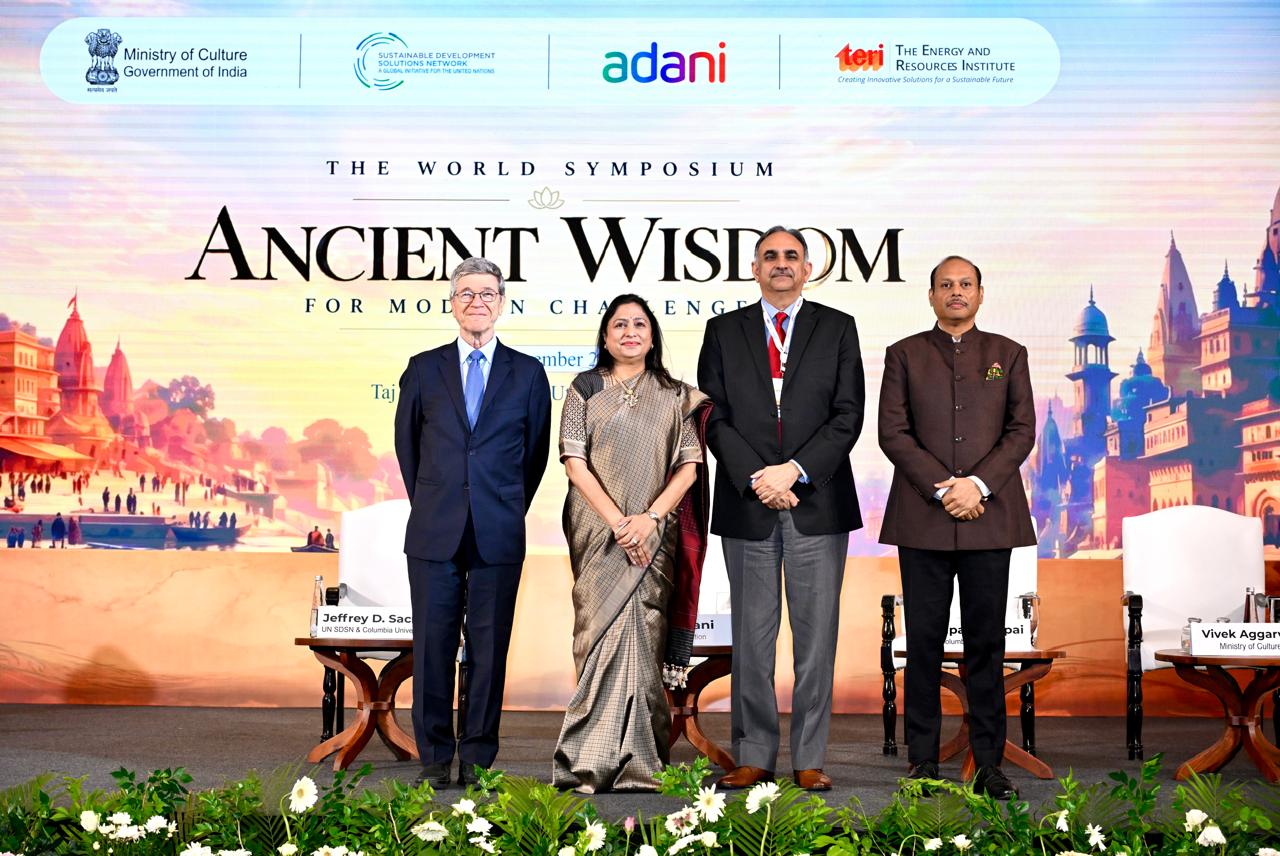
"Ancient wisdom does not become valuable simply because it is ancient. It becomes valuable when we discover its relevance to contemporary problems," she said, calling for civilisational knowledge to be preserved and applied to address suffering, inequality and conflict. "Knowledge gives us the power to change the world. Wisdom assures us that we change it for the better."
Dr Adani referred to Greek philosopher Aristotle and his ideas on human flourishing; Lord Buddha, whose teachings addressed suffering; and Confucius, the ancient Chinese philosopher, whose teachings emphasised ethical conduct, moral responsibility and social harmony. She connected these traditions with India's Vasudhaiva Kutumbakam, or the world is one family, and called for civilisational knowledge to be applied to improve lives and advance sustainable development.
Reflecting on three decades of community development work, Dr Adani said progress must be measured by its impact on people. She described seva, or selfless service, as listening to communities and enabling them to shape their futures. Established in 1996, the Adani Foundation, the Adani Group's social development arm, works across 7,000 villages in 22 states, impacting 13 million lives.
She also highlighted the Bharat Knowledge Graph, backed by an Adani Group commitment of $10 million. It makes India's civilisational knowledge accessible to interdisciplinary research and supports 14 doctoral scholars.
In his address, "The Return of a Multipolar World," Professor Jeffrey D. Sachs, President of the UN Sustainable Development Solutions Network and Director of the Center for Sustainable Development at Columbia University, examined the shifting balance of global economic power and India's growing role in it. He traced India's share of global output from 5.2% in 2000 to 8.5% in 2026, projecting it to reach 13.1% by 2050 and 15.1% by 2100. He also outlined the changing economic balance towards Asia and Africa, with the combined share of the United States, Canada and Europe projected to decline to 13.7% by 2100.
Professor Sachs acknowledged the scale of the work being undertaken by the Adani Group and the Adani Foundation in sustainable development in India and globally. During the subsequent interaction, he described the Adani Group as one of the major drivers of change and progress in India, noting the significant role it plays in the country's infrastructure expansion and economic growth.
He also reflected on the responsibility associated with carrying a family name in business. Contrasting family-led enterprises with corporations driven primarily by shareholder returns, he said businesses carrying a family name also carried its heritage and an obligation to consider what they gave back to society. His observations brought the discussion on India's economic transformation into the wider context of business responsibility and social contribution.
Shri Vivek Aggarwal, Secretary, Ministry of Culture, Government of India, spoke about the enduring strength of India's civilisation and the opportunities offered by technology to make its knowledge more accessible.
"Artificial intelligence can help decipher ancient scriptures, deepen our understanding of their wisdom and make India's civilisational knowledge more accessible and relevant to future generations," said Shri Aggarwal.
Earlier, the inaugural session opened with an address by Dr Nirupam Bajpai, Senior Research Scholar at Columbia University's Center for Sustainable Development. He conveyed Prime Minister Shri Narendra Modi's best wishes for the symposium and spoke about Varanasi's historic role as a meeting place of ideas and spiritual traditions.
The Varanasi symposium is part of an international series that began in Greece, with meetings in Athens in 2022 and Stagira in 2023, followed by gatherings in Qufu and Beijing, China, in 2024.