Bhubaneswar, Nov 2 (UDN): Severe Cyclonic Storm 'Murasu' is moving closer to the Andhra Pradesh coastline, with the India Meteorological Department (IMD) predicting landfall around midnight on Monday.
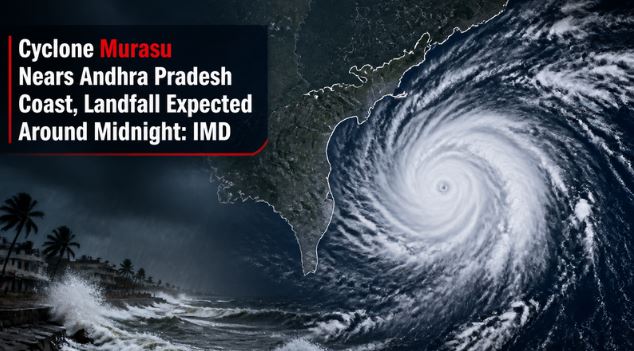
Representational Image
According to the IMD's latest bulletin, issued at 2.30 pm on November 2, the cyclone was centred over the westcentral Bay of Bengal, approximately 100 km east of Nellore in Andhra Pradesh.
The weather system has been moving northwestwards at a speed of around 10 kmph over the past six hours. Its position was estimated near latitude 14.3°N and longitude 80.9°E.
At the time of the bulletin, the cyclone was also located around 120 km southeast of Kavali, 160 km southeast of Ongole, 160 km north-northeast of Chennai in Tamil Nadu and 210 km south of Machilipatnam in Andhra Pradesh.
Landfall Likely Between Nellore And Narsapur
The IMD has forecast that the severe cyclonic storm will continue its northwestward movement before crossing the south Andhra Pradesh coast between Nellore and Narsapur, to the south of Ongole.
The landfall is expected between 11.30 pm on Monday, November 2, and 4 am on Tuesday, November 3.
During the landfall process, the cyclone is likely to pack sustained wind speeds of 100-110 kmph, with gusts reaching up to 120 kmph.
The anticipated wind intensity could pose a serious challenge to coastal areas along the storm's projected path.
Doppler Radars Keep Close Watch On Cyclone
The IMD is maintaining continuous surveillance of Cyclone Murasu through Doppler Weather Radars located at Chennai, Machilipatnam and Visakhapatnam.
These radar installations are tracking the cyclone's movement and intensity as it advances towards the Andhra Pradesh coast.
The weather agency is closely monitoring the system ahead of its expected landfall, which is likely to occur during the late-night hours or early Tuesday morning.