Partnership positions the two companies to support India's fast-growing container shipbuilding ambitions, including the newly launched Bharat Container Shipping Line, by combining German design expertise with Indian engineering execution.
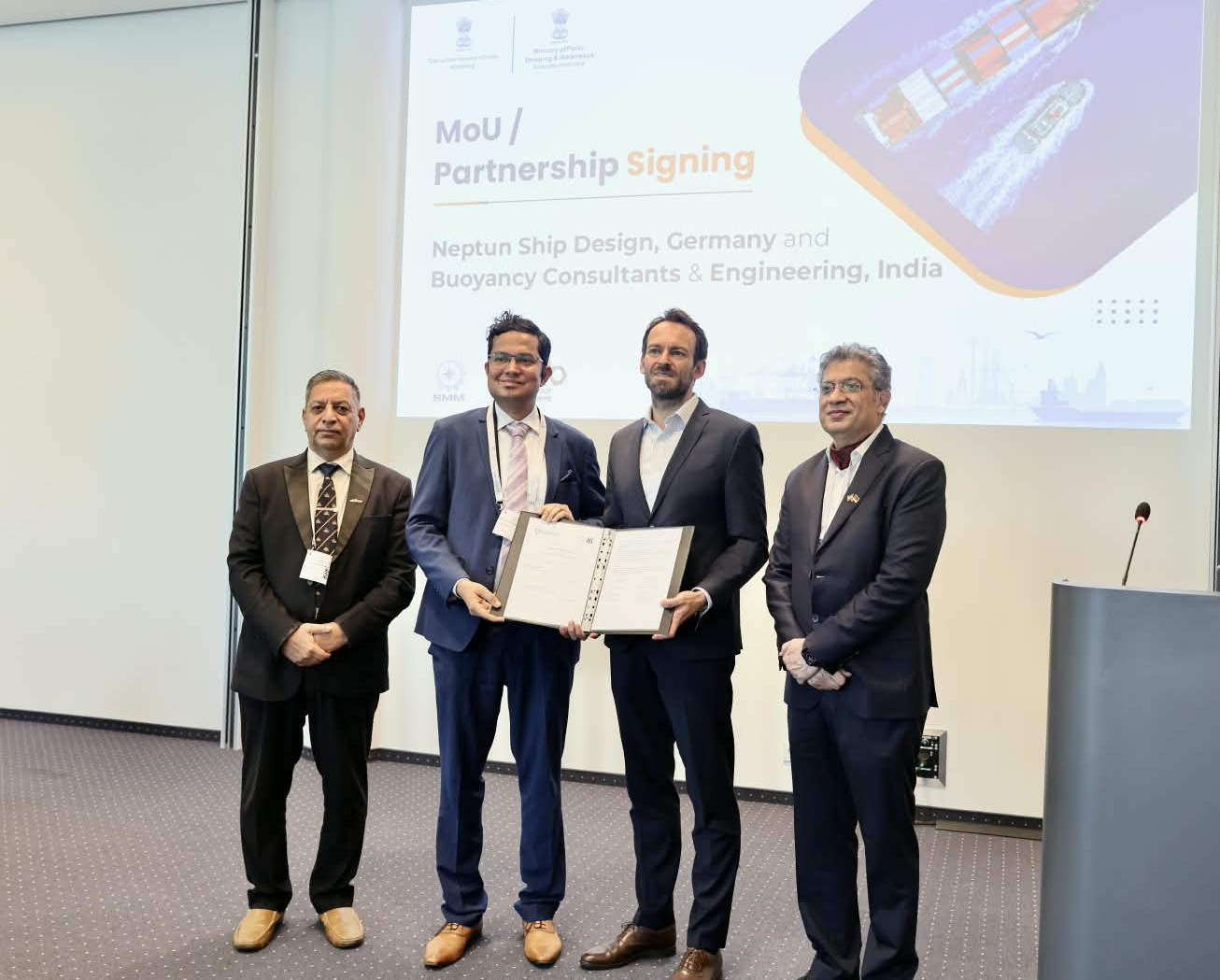
Hamburg, Germany | Sept 04: Against the backdrop of growing India-Germany maritime cooperation, Buoyancy Consultants and Neptun Ship Design GmbH have signed a Letter of Intent (LoI) at SMM Hamburg 2026, one of the world's leading maritime trade fairs.
The strategic collaboration brings together Germany's largest independent ship design company, Neptun Ship Design, and one of India's leading design organisations, Buoyancy Consultants, pairing Neptun's globally recognised ship design expertise with Buoyancy's engineering strength, market insight, and execution capabilities in India. Together, the companies will work on advanced vessel programmes including container vessels, passenger ships, research and science vessels, and other niche and complex maritime assets for both Indian and international markets.
The partnership is expected to accelerate access to internationally proven design solutions, strengthen engineering capabilities, promote knowledge transfer, and support the delivery of complex vessel projects. It will also serve as a gateway for greater India-Europe maritime cooperation, enabling Buoyancy to expand its reach across Germany and wider European markets, while supporting Neptun's growth ambitions in India and across South Asia.
India's Self-Reliant Shipbuilding Push Creates the Backdrop
The LoI arrives at a pivotal moment for Indian shipbuilding. India currently carries only a small fraction of its own export-import cargo on Indian-flagged vessels, with the remainder handled by foreign shipping lines at an annual freight outflow estimated at around USD 75 billion. To close this gap, the Government of India has moved decisively over 2026: in February, the Ministry of Ports, Shipping and Waterways signed the founding Memorandum of Understanding for the Bharat Container Shipping Line (BCSL) — a joint venture between the Shipping Corporation of India (SCI), Container Corporation of India (CONCOR), Jawaharlal Nehru Port Authority, V.O. Chidambaranar Port Authority, Chennai Port Authority, and Sagarmala Finance Corporation.
BCSL is envisaged as a fleet of 51 vessels, owned and chartered, within five years, backed by an estimated ₹59,000 crore (approximately USD 6.4-6.9 billion) in investment. Roughly 15 container ships are planned for order from domestic yards in the coming financial year alone. The initiative is anchored to the Container Manufacturing Assistance Scheme (CMAS) announced in the Union Budget 2026-27, and forms part of the government's wider Atmanirbhar Bharat vision for a self-reliant national container ecosystem — spanning shipbuilding, port infrastructure, and domestic container manufacturing.
This scale of ambition brings with it an equally significant need: world-class ship design capability delivered at Indian cost structures and timelines. It is precisely this gap that the Buoyancy-Neptun partnership is designed to address.
Supporting India's Domestic Container Shipbuilding Vision
As Indian yards prepare to build container vessels at a scale and pace the country has not previously attempted, the Buoyancy-Neptun collaboration is positioned to give Indian shipbuilders and stakeholders — including entities within the emerging BCSL ecosystem — direct access to Neptun's internationally proven container vessel designs, engineering standards, and decades of European shipbuilding know-how. Combined with Buoyancy's local execution capability, market insight, and on-ground engineering strength, the partnership offers a route for Indian programmes to move faster from concept to build, while meeting international classification, safety, and efficiency benchmarks from the outset.
For Neptun, the LoI offers a structured entry point into India's rapidly expanding shipbuilding market at the moment it is scaling — supporting the company's broader growth ambitions across India and South Asia. For Buoyancy, it strengthens the firm's design pedigree and opens a channel into Germany and the wider European market, reinforcing India-Europe maritime cooperation at a time when both regions are looking to deepen collaboration in shipbuilding, defence, and maritime technology.
Paul Brzesina, Managing Director, Neptun Ship Design, said: “India is one of the most promising maritime markets in the world today. The country's vision for strengthening domestic shipbuilding, investments in maritime infrastructure, and commitment to becoming a global manufacturing hub create tremendous opportunities for long-term growth. Through this partnership with Buoyancy, we see a unique opportunity to combine Neptun's decades of international ship design experience with India's exceptional engineering talent and growing industrial capabilities. Together, we aim to contribute to the development of advanced vessel solutions while supporting the evolution of a globally competitive Indian shipbuilding sector”
Prasad Sawant, CEO, Buoyancy Consultants, said: “This partnership represents much more than a business collaboration. It is a strategic step aligned with India's maritime ambitions for 2030 and 2047. Over the years, Buoyancy has delivered ship design and engineering services to clients across the world, and this partnership with Neptun strengthens our ability to bring internationally proven ship design expertise closer to Indian shipyards. We strongly believe that the future of shipbuilding lies in effectively bridging global engineering excellence with India's unmatched talent pool and execution capabilities. Together, we look forward to creating opportunities that benefit both the Indian and European maritime ecosystems.”
As India accelerates its journey toward becoming a leading global shipbuilding nation, the Neptun-Buoyancy partnership is expected to play a meaningful role in enabling access to advanced design capabilities, strengthening domestic engineering expertise, and fostering greater collaboration between two of the world's most important maritime economies.