September 16, 2026: Plaksha University, in collaboration with the Mphasis as part of its commitment to promoting inclusive education and innovation in STEM hosted the second edition of the ‘TrackShift Innovation Challenge’ on September 12–13, 2026, at the Plaksha University campus. The 24-hour applied innovation challenge brought together more than 180 undergraduate and postgraduate student innovators from across India to develop scalable proofs of concept at the intersection of artificial intelligence, mobility and intelligent systems.
Developed as part of Mphasis' multi-year association with the TGR Haas F1 Team, TrackShift 2026 challenged students to apply emerging technologies including computer vision, data science and predictive modelling to engineering problems drawn directly from the realities of elite motorsport. This year's edition placed a sharper focus on applied engineering rigour, with problem statements inspired by the technical constraints and decision-making scenarios of the 2026 racing season.
The challenge drew more than 3600 applications from students across India, including those from IITs, NITs, IIIT-Hyderabad, BITS Pilani, and a significant number of regional and tier 2-3 institutions. Approximately one-third of applicants were female students, a reflection of the initiative's commitment to women in STEM education and broadening participation in high-complexity technology challenges.
This year's challenge featured three problem statements:
-
Energy & Overtake Intelligence: Build a real-time decision engine that recommends optimal energy deployment modes and evaluates the risk-reward ratio of overtake windows.
-
Track Limits Detection: Develop an AI-powered video analysis system to detect track-limit violations using computer vision and car telemetry.
-
Tyre Degradation Intelligence: Create a predictive model that strips external noise from practice sessions to generate clean tyre performance degradation curves.
Solutions developed during the challenge will be made available through an open repository on the TrackShift website, accessible to industry partners, academia, startups and research labs ensuring that promising ideas can continue to evolve beyond the challenge itself.
"Engineers are shaped by the problems they are given. TrackShift puts that belief to the test every year, and this edition, with its focus on overtake intelligence, track limit detection and tyre degradation intelligence, pushed students into the kind of complexity our industry partners deal with daily. That is the standard we want our graduates to be ready for,” said Prof. M. Balakrishnan, Distinguished Visiting Professor, Plaksha University.
“The TGR Haas F1 Team partnership gives TrackShift something rare: engineering problems with real stakes and real complexity. What excites me is that students from IITs and from tier 2 colleges across India are sitting in the same room, working on the same hard problems that professionals at the frontier of motorsport technology deal with every day. That is exactly the kind of talent pipeline India's technology industry needs and the kind Mphasis is committed to building,” said Veda Iyer, Global Chief Marketing Officer, Head of Hyperscalers & Strategic Partnerships, and Head Sales- APAC, Mphasis.
“Motorsport brings together some of the most complex challenges in engineering, data and technology, and TrackShift allows students to engage with these challenges from a practical perspective. By working on problems inspired by the realities of motorsport, participants were able to apply their technical knowledge, explore new approaches and develop solutions that have relevance beyond the track. It was particularly interesting to observe how the students approached this year’s challenges and the fresh perspectives they brought to these complex engineering problems,” said Jason Kew, Head of Information, TGR Haas F1 Team.
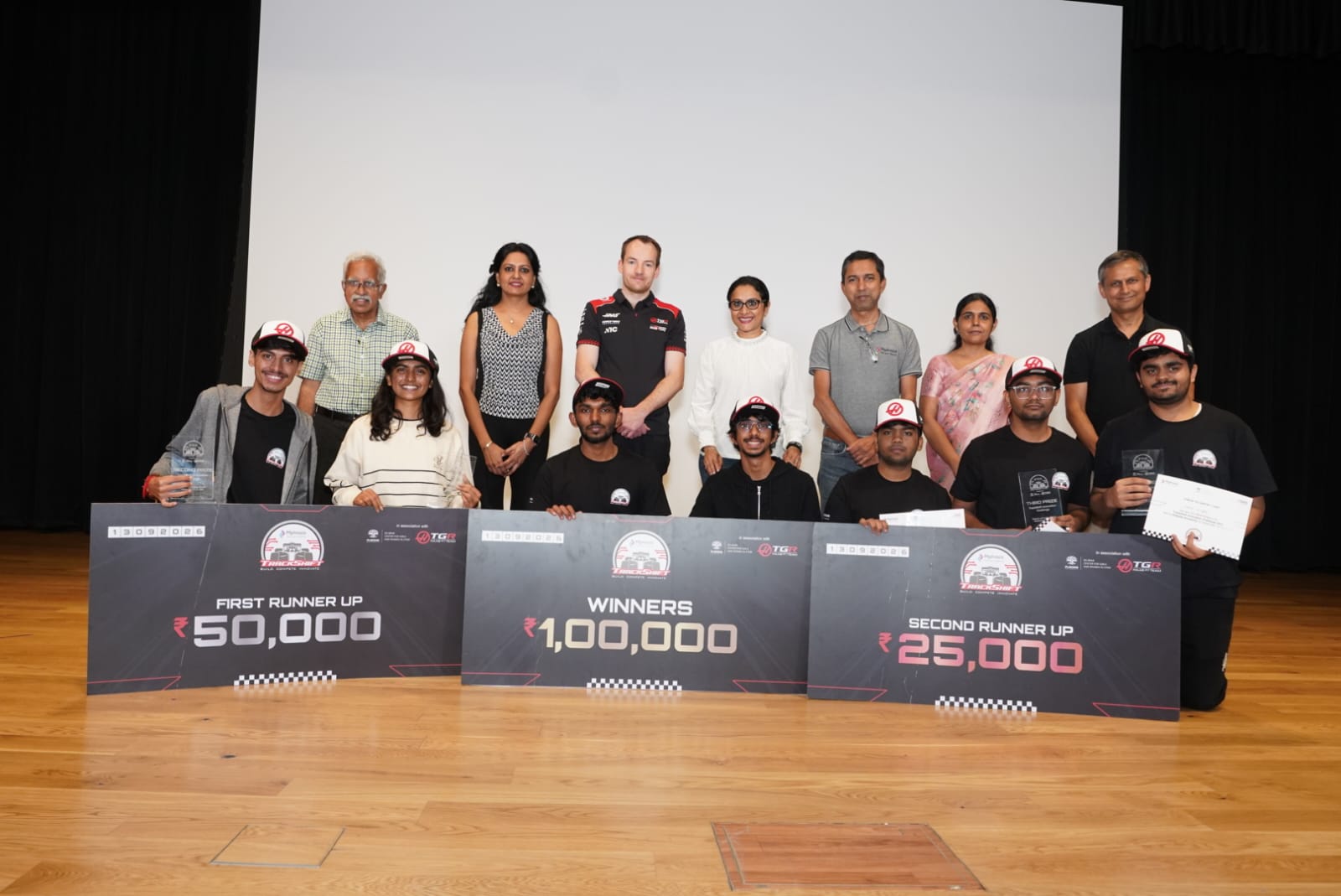
The top three winning teams received cash prizes of ₹1,00,000, ₹50,000, and ₹25,000, respectively, along with mentorship-based internships at Mphasis. The winning teams are:
-
1st prize: Vellore Institute of Technology, Vellore
-
2nd Prize: Yeshwantrao Chavan College of Engineering (YCCE), Nagpur
-
3rd prize: Maharaja Agrasen Institute of Technology, Delhi
The top three teams will receive a share of the cash prize along with a fully sponsored visit to the TGR Haas F1 Team facility in the United Kingdom. Selected participants will receive mentoring during their internship (up to two months) at Mphasis., working on live AI and innovation projects. Participants will receive innovation kits and certificates, meet industry experts, academic leaders and the TGR Haas F1 Team, along with networking opportunities with global technology leaders.